
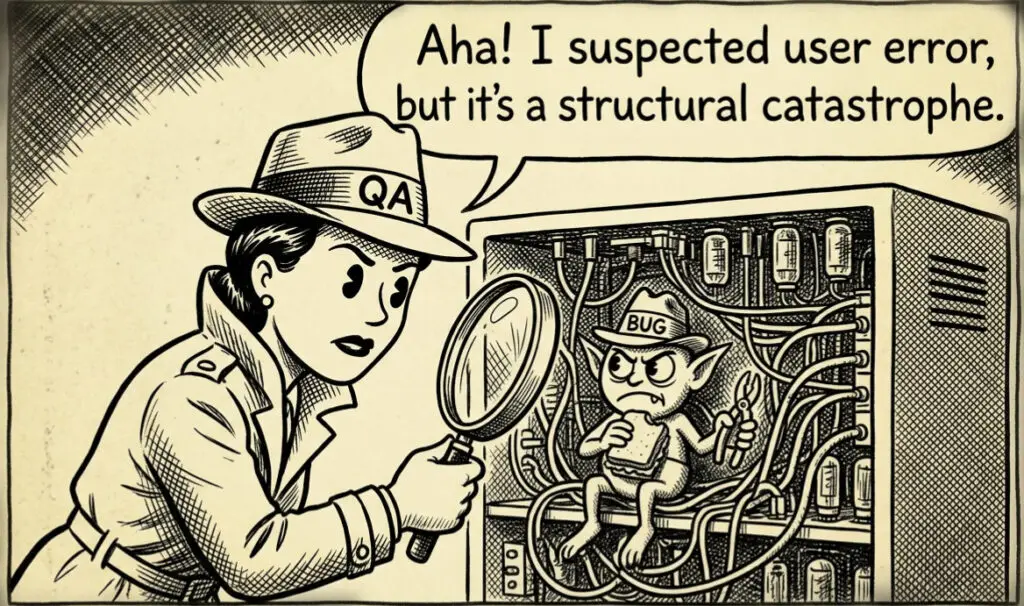
In the fast-paced world of digital development, achieving flawless software quality assurance is the ultimate goal. Software testing and QA (quality assurance) are no longer just the final checkboxes before a product goes live; they are the critical lifelines that prevent catastrophic, meme-worthy system crashes. Whether you are implementing automated testing protocols, leveraging cutting-edge AI-driven QA tools, executing rigorous manual test cases, or hunting down elusive regressions, a robust QA strategy ensures your application delivers a seamless user experience. Because let’s be honest: nobody wants their app to become a trending topic on Twitter for all the wrong reasons.
The Eternal Struggle: Devs vs. Testers
If software development is the art of creation, then software testing is the fine art of constructive destruction. Developers look at their code like a proud parent looking at a newborn baby. They truly believe it is perfect, beautiful, and incapable of doing any wrong.
Then enters the QA engineer.
A tester looks at that same code the way a detective looks at a shady suspect in an interrogation room. They don’t see a masterpiece; they see a fragile house of cards waiting to collapse if someone breathes too hard. Developers build the amusement park rides, but QA engineers are the brave souls who ride them until the wheels fly off—all in the name of “quality assurance.”
Why We Can’t Have Nice Things (Without QA)
Without a dedicated software testing process, the digital world would descend into absolute chaos. Imagine a world where:
The “Add to Cart” button accidentally deletes your bank account.
A simple font change somehow breaks the entire database login screen. Don’t laugh, it happens.
A smart fridge decides to lock you out until you update its firmware.
Software bugs are devious little creatures. They love to hide in the dark corners of your codebase, waiting for the exact moment your CEO decides to do a live product demonstration. That is when they strike. A good QA team acts like an exorcist for your software, purging these digital demons before they ever reach a real user.
Pro Tip: If you think your code doesn’t have bugs, you just haven’t let a QA engineer touch it yet. They will find a way to break it by typing “
” into a phone number field.
Enter the Machines: AI in Software Testing
Now, let’s talk about the new kid on the block: Artificial Intelligence. AI is completely flipping the script on traditional software quality assurance. We aren’t just talking about basic automation scripts anymore; we are talking about intelligent systems that can look at code, predict where the bugs are hiding, and write their own test cases.
It turns out AI is incredibly good at the stuff humans find mind-numbing. It can analyze millions of lines of historical data to say, “Hey, every time Dave touches the checkout logic, everything breaks. Maybe we should test that area extra hard today.”
AI-driven testing also brings “self-healing” tests to the table. In the old days, if a developer changed a button ID from login_btn to submit_btn, the entire automated test suite would shatter into a million pieces, prompting a midnight emergency page to the QA team. Today, an AI model looks at the change, realizes it’s still just a button, updates the script automatically, and goes back to sipping its digital tea.
Of course, AI has its own quirks. If you don’t train it properly, it might decide that the easiest way to ensure there are zero bugs in the application is to simply delete the entire codebase. Problem solved, right?
The QA Balancing Act: Manual, Automated, and AI
With AI in the mix, the modern software testing ecosystem has evolved into a three-headed beast, each with its own superpower.
+-------------------------------------------------------------------------+
|                        THE MODERN QA TRIAD                              |
+--------------------+----------------------------+-----------------------+
| Manual Testing     | Traditional Automation     | AI-Driven Testing     |
+--------------------+----------------------------+-----------------------+
| Human intuition,   | Fast, rigid, and repetitive| Predictive analysis,  |
| UX evaluation, &   | scripts. Executes exactly  | self-healing scripts, |
| creative edge-cases| what it is programmed to.  | & auto-generated tests|
+--------------------+----------------------------+-----------------------+
While AI handles predictive analysis and automation handles the repetitive heavy lifting, you still need real human eyes. A robot can check if a feature functions, but it can’t tell you if the user interface feels clunky or if a flashing neon banner is giving your users a headache.
Conclusion: Hug Your Nearest Tester (and their AI assistant)
At the end of the day, software testing and QA aren’t about pointing fingers or making developers cry (though that is sometimes a side effect). It’s about building a product that people can actually trust. So the next time a QA engineer or their shiny new AI co-pilot rejects your pull request, don’t get mad. Buy them a coffee (or plug in their charger). They just saved you from an angry mob of users.