
BLOG
Mastering Date and Time Edge Cases in Software Testing
- February 23, 2026
If you want to watch a senior software engineer age ten years in ten seconds, walk up to them and say: “Hey, we need to add multi-timezone support to our booking system.” Date and time logic is a notorious breeding ground for catastrophic production bugs. To a computer, time is supposed to be a linear sequence of ticks. To humans, time is non-linear, arbitrary, and riddled with political anomalies (looking at you, Daylight Saving Time). For QA professionals and automation engineers, handling these temporal anomalies requires rigorous boundary value testing and a deep understanding of historical and future edge cases.
If your application handles scheduling, financial transactions, or data logging, here are the critical date and time boundaries you must build into your software testing strategy.
1. The Leap Year Glitch (The February 29th Trap)
Leap years happen every four years—except when the year is divisible by 100 and not by 400. Yes, the year 2000 was a leap year, but 2100 will not be. Developers frequently write simplified modulo math (year % 4 == 0) that completely overlooks this rule, resulting in code that derails on February 29th.
When designing QA test scenarios for subscriptions, insurance policies, or scheduling software, you must simulate end-to-end transactions across leap boundaries.
Key Test Scenarios:
The Anniversary Shift: What happens to a monthly subscription billed on February 29th when it transitions into a non-leap year? Does the system bill on February 28th, March 1st, or skip the month entirely?
The Leap Day Birthday: Validate age-verification logic for users born on February 29th. Does the system recognize them as legal adults on February 28th or March 1st in common years?
2. The Daylight Saving Time (DST) Transition
Twice a year, the clock plays tricks on software infrastructure. In the spring, an hour vanishes into thin air; in the autumn, an hour repeats itself.
Consider the real-world impact on IoT or medical systems: an automated medication dispenser programmed to deliver a dose every hour. During the autumn “fallback,” that 1:00 AM hour occurs twice. Without precise logic, the machine could double-dose a patient.
Standard Timeline:  [12:00 AM] ---> [1:00 AM] ---> [2:00 AM]
DST Autumn Fallback: [12:00 AM] ---> [1:00 AM (A)] -> [1:00 AM (B)] -> [2:00 AM]
Key Test Scenarios:
Duplicate Execution: When testing cron jobs, background workers, or event queues, ensure tasks scheduled during the repeating autumn hour do not execute twice.
The Impossible Hour: Ensure that events scheduled during the missing spring hour (e.g., 2:30 AM during a skip from 2:00 AM to 3:00 AM) are gracefully pushed forward or handled via UTC offsets rather than crashing the system thread.
3. Epochal Limits: The Year 2038 Problem (Y2K38)
You have likely heard of Y2K, but the Year 2038 problem is a looming reality for legacy backend architecture. Many systems store time as the number of seconds elapsed since January 1, 1970 (Unix Epoch Time) using a 32-bit signed integer.
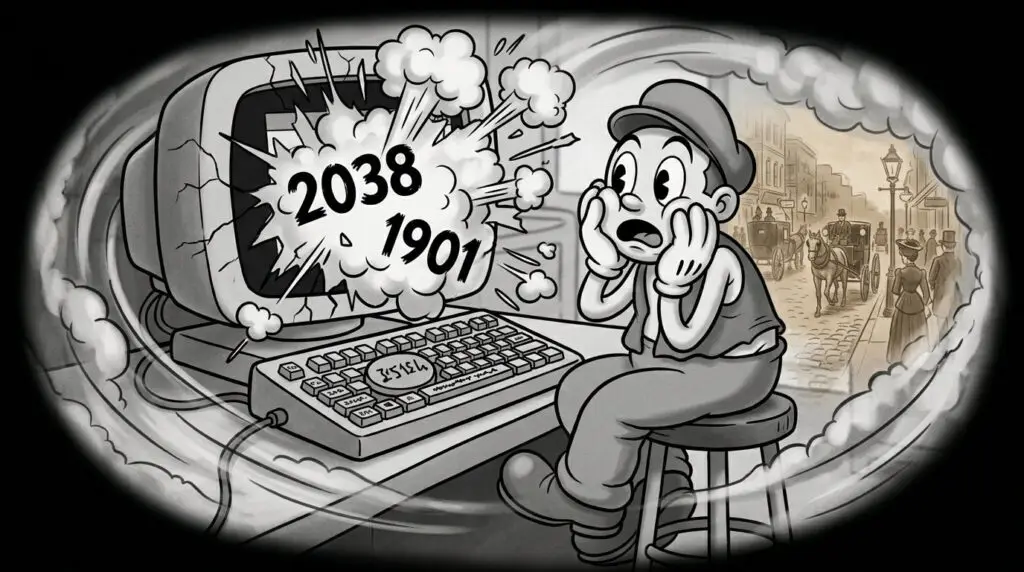
On January 19, 2038, that integer boundary will be breached. The value will overflow, wrapping around to a negative number, instantly resetting the system clock to 1901.
32-Bit Signed Integer Max:  2,147,483,647 seconds  -> Jan 19, 2038
Integer Overflow Trigger:  -2,147,483,648 seconds  -> Dec 13, 1901
If you are auditing or testing long-term financial products, such as 30-year mortgages or retirement funds, your application is already calculating dates past 2038.
Key Test Scenarios:
Data Type Verification: Verify that database schemas, API payloads, and variable definitions utilize 64-bit integer formats (
BigIntor 64-bit timestamps) instead of legacy 32-bit types.Far-Future Calculations: Run boundary tests using inputs set to 2040 and beyond to evaluate how third-party integrations and internal date libraries handle post-epoch math.
4. Time Zone Anomalies and Floating Local Times
Testing in a single local environment often masks insidious timezone bugs. The most common pitfall occurs when frontend applications capture time in the user’s local zone, but the backend processes it without explicit timezone context, resulting in data corruption when viewed globally.
Furthermore, some geographic regions alter their UTC offsets with very little notice due to geopolitical decisions. Relying on hardcoded offsets instead of dynamic timezone databases (like the IANA Time Zone Database) is a massive risk.
Key Test Scenarios:
The Cross-Midnight Booking: Test a flight or hotel reservation made by a user in Tokyo (UTC+9) for a property in New York (UTC-5). Ensure the check-in date does not shift backward on the confirmation ticket due to unhandled conversions.
ISO 8601 Standardization: Confirm that all date-time strings passed through API endpoints utilize the standard ISO 8601 format (e.g.,
2026-06-22T21:50:57Z) to preserve universal context across microservices.

Summary: The Date-Time QA Test Matrix
To help your engineering team implement comprehensive boundary value testing, use this reference matrix during your next sprint planning or test design phase:
| Edge Case Category | Primary Risk Factor | Critical Test Input / Action | Expected Behavior |
| Leap Year Boundary | Incorrect modulo logic leading to missing or invalid dates. | Input 2028-02-29 and 2100-02-28. | Code handles Feb 29 smoothly in true leap years; gracefully rolls over to March 1 in non-leap centuries. |
| DST Shift (Spring) | Missing hour causing missing database logs or hung processes. | Simulate system state change during the local clock jump forward. | Scheduled events execute at the corrected forward-shifted offset time. |
| DST Shift (Autumn) | Duplicate hour leading to double-billing or double-processing. | Trigger transactions during the repeated hour block. | Idempotency keys or UTC timestamps prevent duplicate processing. |
| Epoch Overflows | 32-bit integer overflow reverting time to the year 1901. | Input calculation dates extending to 2039-01-01 or later. | System calculates future dates seamlessly without arithmetic overflow errors. |
| Timezone Synchronization | Local-to-Server clock mismatches shifting calendar dates. | Perform transactions across wide UTC deltas (e.g., UTC-10 to UTC+12). | Database normalizes all timestamps to UTC, while the UI renders correct local equivalents. |
Conclusion
When it comes to date and time logic, defensive programming must be matched by defensive testing. Never assume a date library handles every edge case natively, and never trust local machine time for distributed systems. By embedding these four temporal boundaries directly into your test suites, you can ensure your software remains resilient, compliant, and accurate—no matter what the clock says.