
BLOG
PII Data Masking in Test Environments: Strategies for Secure DevOps
- June 15, 2026
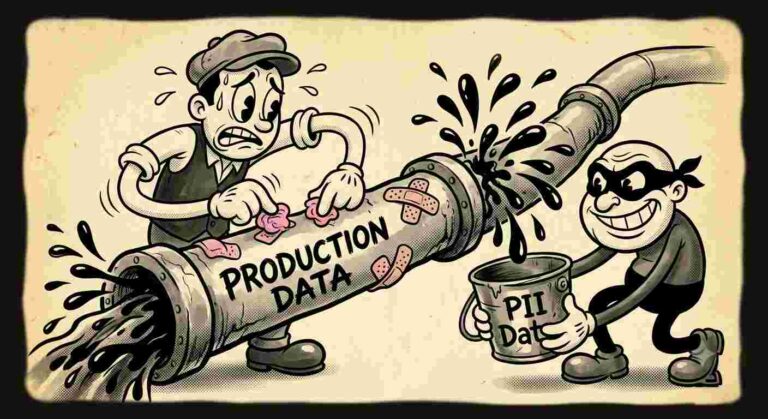
In the modern software development lifecycle, ensuring PII data masking in test environments is a critical operational mandate for technical and cybersecurity teams. Engineering teams frequently fall into the trap of cloning live production databases directly into staging, testing, and development environments to provide high-fidelity datasets for testing complex business logic. However, when these environments contain unmasked Personally Identifiable Information (PII) such as full names, national insurance numbers, medical records, or financial credentials, they open up massive vulnerabilities. Unsanitised test environments expose organisations to severe cyber threats and regulatory non-compliance, making robust data anonymisation strategies a foundational requirement for secure software testing.
Why Masking PII is Mandatory
Moving raw production data into testing environments expands an organisation’s cyber-attack surface exponentially. While production environments are guarded by stringent perimeters, real-time threat detection, and tightly restricted access controls, non-production environments are inherently designed for flexibility, speed, and collaborative access.
They are routinely accessed by:
- Internal developers and quality assurance (QA) engineers.
- Third-party contractors and offshore development partners.
- Automated CI/CD pipelines and performance testing tools.
Allowing these entities access to unmasked PII violates the core cybersecurity principle of Least Privilege. Furthermore, international regulations have criminalised the careless handling of consumer information. Under the UK General Data Protection Regulation (UK GDPR) and the Data Protection Act 2018, organisations must strictly adhere to the principle of purpose limitation. Data collected to fulfill a live service cannot simply be repurposed for testing without explicit consent or robust pseudonymisation. Non-compliance invites devastating financial penalties—up to £17.5 million or 4% of global annual turnover—alongside irreparable loss of market trust.
Advertisement



Strategic Approaches to Data Masking
To maintain realistic datasets without compromising structural data integrity or security, engineering teams must implement mature data masking and anonymisation strategies.
- Static Data Masking (SDM)
- SDM is the absolute gold standard for non-production environments. The process extracts a copy of the production data, applies permanent transformation algorithms within a secure staging boundary to overwrite sensitive data, and then loads the sanitised copy into the test environment. Once applied, the transformation is irreversible, meaning the original data cannot be reverse-engineered from the test sandbox.
- Substitution and Pseudonymisation
- Substitution replaces genuine database values with realistic, syntactically correct, but entirely fabricated variants fetched from an internal lookup dictionary. For instance, authentic customer names are replaced with random names, and real postcodes are swapped out for validly formatted dummy postcodes. This preserves the formatting rules required by application front-ends while stripping away the actual identity.
- Tokenisation and Column Shuffling
- Tokenisation: Replaces sensitive elements (like credit card primary account numbers) with cryptographically generated tokens, isolating the database completely from the decryption keys.
- Shuffling: Randomises values within a specific column across different rows. For example, in an HR database table, shuffling salaries across the user list ensures that the total financial distributions, sums, and averages remain perfectly accurate for analytical or performance stress-testing, yet individual salary records are fully decoupled from their actual owners.
- Number and Date Variance
- Numeric and date fields can be shifted using a random percentage or fixed offset variance. A cardholder’s date of birth can be offset by a random number of days within a strict parameter (e.g., +/- 15 days). This approach preserves age demographics and chronological logic essential for testing validation rules while making individual tracking impossible.
Real-World Failures: The Cost of Inaction
The danger of failing to secure data outside of core, hardened production environments is illustrated by several high-profile corporate security breaches.
Uber Data Breach (2016)
In late 2016, external attackers breached a private GitHub repository utilized by Uber software engineers by using compromised credentials. Within that repository, the attackers uncovered login credentials to an Amazon Web Services (AWS) account used by the engineering team. Because backups containing unmasked production data were accessible via this development-linked environment, the attackers easily harvested the personal records of over 57 million riders and drivers. This led to massive regulatory fines and an immense public relations crisis.
Equifax Breach (2017)
While the primary entry vector for the catastrophic Equifax cyber-attack was a known unpatched vulnerability in an online dispute portal, the lateral movement and data harvesting inside the network were severely exacerbated by poor data minimisation and internal database isolation. Once inside, attackers discovered unencrypted database credentials that allowed them to query dozens of internal, interconnected legacy production databases. This lack of robust internal compartmentalisation led to the exposure of 147 million consumers.
Technical Execution Checklist
DevOps, QA, and security teams should embed the following practical checklist directly into their automated database deployment pipelines to ensure comprehensive data sanitisation:
☐ 1. Automated Data Discovery and Classification, Continuously run automated schema scanning tools across the entire production database layout to map all fields containing PII, financial details, and sensitive system metadata.
☐ 2. Enforce Referential Integrity. Configure transformation algorithms to ensure that primary and foreign key links across all related database tables remain fully unbroken post-masking, preventing catastrophic application crashes during integration testing.
☐ 3. Preserve Data Formats and Validation Syntax. Ensure masking patterns strictly match valid formatting lengths, prefix strings, and check-digit rules (e.g., maintaining the Luhn algorithm for credit cards) so that downstream system validations do not falsely reject the test data.
☐ 4. Shift Left: Automate within the CI/CD Pipeline. Integrate Static Data Masking directly into the database backup-and-restore automation scripts. Ensure data is completely anonymised before it ever leaves the secure production environment boundaries.
☐ 5. Irreversibility Validation. Subject the masked datasets to periodic mathematical and cryptographic reviews to ensure that the scrambled values cannot be re-identified through demographic cross-referencing or inference attacks.
☐ 6. Restrict Masking Logic Access. Implement strict role-based access control (RBAC) over the lookup dictionaries, masking scripts, and seed configurations to prevent unauthorized users from uncovering the underlying logic.
Conclusion
Masking production PII before it arrives in testing environments is no longer just a defensive operational recommendation; it is an absolute cornerstone of modern cyber resilience and regulatory compliance. Treating staging environments as casual playgrounds for raw corporate data creates an open invitation for malicious actors. By adopting robust Static Data Masking techniques, enforcing consistent data structures, and incorporating automated data sanitisation pipelines, engineering departments can achieve rapid development cycles without compromising consumer privacy or corporate data integrity.